Completing inpatient treatment is a significant clinical milestone, and it's also the beginning of a whole new set of challenges. The structure that surrounds a patient during inpatient care, the schedule, the staff, the therapeutic programming, and the community of people all working toward the same goal, falls away at discharge.
What replaces it matters enormously, maybe more than people expect going in. Research on relapse consistently identifies the transition from inpatient to community living as one of the highest-risk periods in recovery, and community support groups are among the most effective tools for managing it.
At Arms Acres, a trusted rehab facility in New York, long-term recovery support is something we take seriously as part of our clinical responsibility to the people we treat. That responsibility doesn't end at discharge.
Through our outpatient clinics in the Bronx, Queens, and Carmel, recovery coaching services, and the Alkathon alumni program, we stay connected to patients well beyond the inpatient stay, because the support structures a person has after treatment shape outcomes just as much as the treatment itself.
Why Isolation Is One of the Most Serious Risks After Treatment
Addiction tends to narrow a person's social world over time. Relationships with people who don't use substances often erode, sometimes without anyone quite noticing until it's already happened.
The social life that develops around substance use may honestly be the most active social life a person has had in years. When they get sober, that world disappears, and what's left can feel empty in ways that are clinically dangerous.
Isolation is one of the most reliable predictors of relapse, not because people who are isolated lack determination, but because the human nervous system is built for social connection. Without it, stress gets harder to manage, perspective gets harder to hold onto, and memories of what substances felt like tend to grow more vivid when no one else is there to compete for that space.
This is where the role of peer support comes in, offering a ready-made community of people who understand recovery from the inside, no explanation or persuasion needed.
What Community Support Groups Actually Provide
The most widely recognized community support model in addiction recovery is the 12-step framework, which includes groups like Alcoholics Anonymous and Narcotics Anonymous.
These groups have decades of documented use behind them and a structure that works for a lot of people:
- regular meetings
- a step-based recovery process
- sponsorship relationships
- a culture of mutual accountability.
At Arms Acres, 12-step meetings are part of our inpatient programming, so patients get familiar with the format and can identify meetings they connect with before they even leave.
SMART Recovery groups offer a different model for patients who'd rather work from an approach grounded in cognitive and behavioral techniques than a spiritual framework. SMART draws on tools from Cognitive Behavioral Therapy and Motivational Interviewing to help members manage cravings, build motivation for change, and problem-solve around the practical stuff recovery brings up.
We offer both because people respond differently, and it helps patients see what each looks like before deciding what fits. It also ties into how group therapy in addiction treatment programs works, giving patients a clearer sense of the structure before they commit to it.
The Difference Between Group Therapy and Peer Support Groups
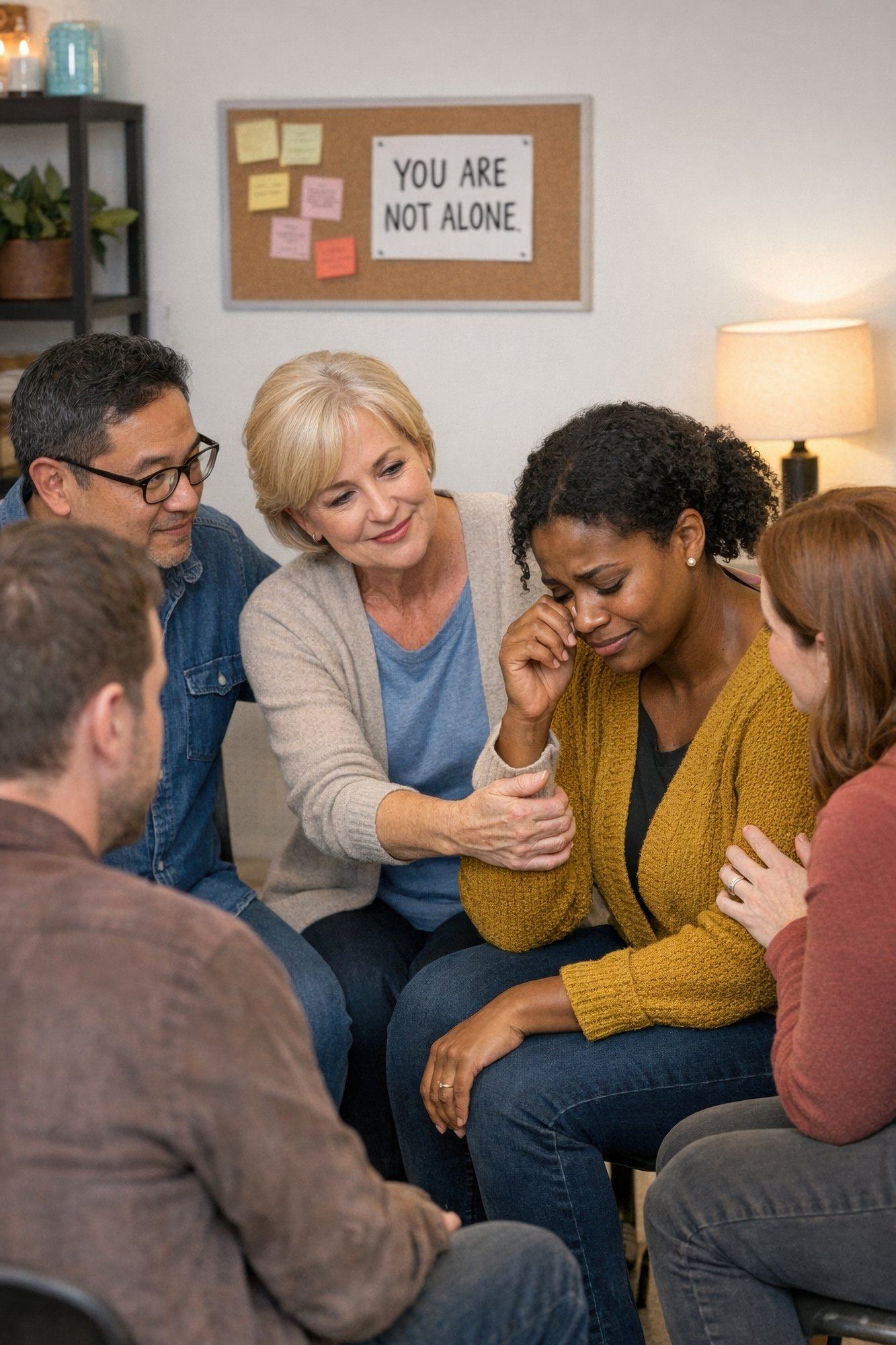
These two types of group experience serve different purposes, and understanding that difference helps patients build a realistic post-discharge support plan.
Group therapy in a clinical setting is facilitated by a licensed professional, structured around specific therapeutic goals, and focused on clinical outcomes. The content is shaped by a clinical framework and moves at a clinical pace.
Peer support groups in the community are facilitated by people with lived recovery experience, not clinicians. They're built around mutual support and shared experience rather than therapeutic goals. What they offer is something clinical care just can't replicate: the sustained, consistent presence of people who've been exactly where you are and come through it.
Both kinds of support have a place in a well-built recovery plan, and neither one replaces the other. A lot of people in long-term recovery keep both going, therapy for the clinical work and peer groups for community and accountability.
Not sure what the first few months after treatment might look like for your family? Call us at 888-227-4641, and our team can talk you through what ongoing support actually involves.
How the Alkathon Alumni Program Supports Ongoing Recovery
The Alkathon program is the alumni community at Arms Acres. It meets monthly at our Carmel campus and brings together people who've completed treatment here at very different stages of recovery, from those newly out of inpatient care to people who are years into sustained sobriety. The format is peer-to-peer, people further along share their experience directly with those who are earlier in the process.
This carries a kind of value that formal programming just can't quite replicate. Hearing from someone who sat where you are now, made it through those same early months and the challenges that came with them, and is now on the other side offers a kind of proof that clinical statistics and professional encouragement can't really match.
For patients struggling to picture a future without substances, that personal testimony carries real weight. The Alkathon exists because we believe recovery is something our patients and alumni do together, not something that ends the day someone leaves our campus.
Building a Support Network Before Discharge
One of the practical priorities in our discharge planning process at Arms Acres is helping patients identify and start building their post-treatment support network before they ever leave the inpatient setting.
That means connecting them with outpatient clinic resources, walking them through how to find 12-step or SMART Recovery meetings back home, introducing them to alumni programming, and our recovery coach services, so they have a clear picture of what those first weeks after discharge will actually look like.
Recovery doesn't sustain itself in a vacuum. It needs conditions that support it, and for most people, those conditions have to be built on purpose, a bit at a time. The clinical work done during inpatient treatment lays the foundation.
Community, whether through formal support groups, alumni programming, recovery coaching, or just a network of people who get what recovery asks of a person, is what helps that foundation hold over the years that follow.
If you have questions about our community and alumni support programs, our intake team is here to help, day or night. You can contact us online or call 888-227-4641, 24 hours a day, 7 days a week.
Related Topics: