

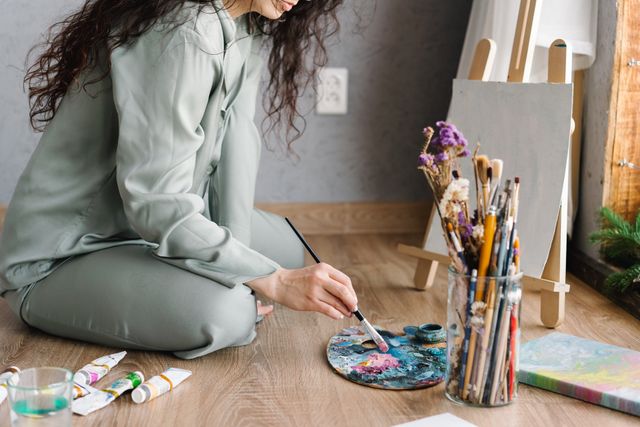
Art therapy helps people in addiction treatment reach feelings they cannot yet put into words, which matters because a great deal of what drives substance use was never verbal to begin with. In our program, it is run by experienced art therapists and sits alongside counseling rather than replacing any of it.
Patients are often doubtful before their first session, usually because they assume it requires artistic ability or that it will feel childish. Neither turns out to be true. What follows explains what actually happens in these sessions inside residential rehabilitation at our Carmel campus and why they earn their place in a clinical schedule.
What Creative Therapy Is Meant to Do
Creative therapy uses making something as the route into clinical material. A patient works with paint, clay, collage, or another medium, and the therapist pays attention to what emerges in the process and in the conversation around it. The finished piece is not the point and is never judged.
The reason this works comes down to how difficult experiences get stored. Trauma, shame and grief frequently sit outside language, which is why a person can recite the facts of what happened in a flat, rehearsed way and feel nothing. Putting the feeling into color and shape bypasses that version entirely.
It also lowers the stakes. Talking about the worst period of your life to a stranger in week one is a lot to ask. Making something while the conversation happens sideways is easier, and for some patients it is the first session where anything real surfaces.
Who Benefits Most From These Sessions
Art therapy tends to reach three groups particularly well, though the sessions are open to anyone in the inpatient program.
The first is patients who have been through treatment before. Someone on their third admission has given the verbal account of their addiction many times and can deliver it on autopilot. A creative session has no script to fall back on, which is frequently where the genuine material finally appears.
The second is patients carrying significant trauma. Trauma-Informed Care, the approach shaping how we treat people with a trauma history, is built around not forcing disclosure. Creative work lets a patient move at their own pace and stop when they need to. The third group is anyone who simply finds talking hard.
How Creative Work Connects to the Clinical Program
These sessions are not a separate activity running off to one side. What comes up in an art therapy session feeds into the broader treatment plan, because our clinical team works as one group rather than in parallel tracks.
A patient who produces something dominated by a particular relationship, or who becomes distressed around a theme, has given the team information that individual counseling can take up properly. Experiential work of other kinds runs on the same logic, which is why our horse-assisted therapy sessions sit in the same part of the schedule.

Where creative therapy fits in a treatment week
- Alongside individual counseling, which takes up what surfaces
- Alongside group therapy, where patients hear their situation reflected by others
- Alongside psychiatric care, where a mood or trauma picture needs clinical attention
- Alongside physical programming, which rebuilds sleep and stress tolerance
- Alongside nutrition education and recreation scheduled through the week
Wondering whether this kind of programming is part of our treatment?
Our intake team can explain what a treatment week actually contains and verify your insurance before admission. Someone answers the line every hour.
What Emotional Regulation Looks Like in Practice
Emotional regulation means being able to feel something intense without immediately acting on it, and losing that capacity is a large part of what addiction does. Substances provide a fast, reliable way to change how you feel, and after years of that, sitting with discomfort stops being a skill a person has.
Creative sessions rebuild it quietly. A patient who works through frustration at a piece that is not going right, and stays with it rather than walking out, has practiced something relevant to a difficult evening six months after discharge. Nobody frames it that way, which is part of why it works.
The same principle runs through how recreational therapy supports emotional regulation and through our fitness and recreation programming. Structured activity that demands attention and produces a result is useful precisely because recovery asks people to tolerate ordinary difficulty without reaching for relief.
What Happens to This Work After Discharge
Formal art therapy sessions belong to the inpatient program, but what patients take from them does not stop at the gate. A number of people carry on with creative practice independently, and some find it becomes a reliable part of how they manage a bad stretch.
Our outpatient clinics in the Bronx, Queens, and Carmel continue the counseling and psychiatric follow-up that creative work fed into, so the clinical thread holds after the sessions end. Recovery coaching carries on, and our monthly Alkathon alumni gatherings bring people back long after discharge.
What matters is that a patient leaves knowing something about how they process difficulty. For some, that is a creative outlet; for others, exercise or a group or a person they call. The programming helps each patient find out which, while clinical support is still around them.
Frequently Asked Questions
Q: Do I need to be good at art to take part?
A: No. Artistic skill is irrelevant, and nothing produced is assessed or displayed without the patient's agreement. The value lies in the process rather than the result.
Q: Is art therapy part of the inpatient program at Arms Acres?
A: Yes. Art therapy is offered as part of our inpatient programming and is facilitated by experienced art therapists at our Carmel campus.
Q: Does creative therapy replace counseling or medication?
A: No. It runs alongside Cognitive Behavioral Therapy, Motivational Interviewing, Trauma-Informed Care, psychiatric services, and Medication-Assisted Treatment where clinically indicated.
Q: Is Arms Acres accredited?
A: Yes. We are accredited by the Joint Commission, licensed by the New York State Office of Alcoholism and Substance Abuse Services, and hold SAMHSA certification as an Opioid Treatment Program.
Contact Us
If you are considering treatment for yourself or someone you care about, our team will answer plainly and without pressure. We have treated addiction in New York since 1982.
Address: 75 Seminary Hill Road, Carmel, NY 10512
Intake: 888-227-4641, answered 24 hours a day
Email info@armsacres.com
Related Topics:
- Family Treatment Programs: How to Support Your Loved One's Recovery in Carmel Hamlet, NY
- Exploring Medication-Assisted Therapy (MAT) for Alcohol Use Disorder in Carmel Hamlet, NY

